


“This is the second part of the interesting article by Erik Van Woerkens that we published a few days ago in our blog. Once again, thank you Erik.”
WRITTEN BY
ERIK VAN WOERKENS
The fourth thing to remember is that in-house is not always what you expect from in-house.
What quality can one expect from luxury brands that start developing their own in-house movement? Those brands will try to hire one or more really good watchmakers for sure, and they will have to develop an alternative for the proven design and reliability of ETA’s and alike workhorses. One can only hope they will make as little design flaws as possible. This is not fiction. Even Patek Philippe had to redesign and enhance the movements used in early Calatrava’s.
- As all of today’s R&D is done using computer aided design, I see a risk of new in-house designs being more complicated and more prone to flaws. For sure with completely new layouts, like MB&F,
My viewpoint is that consumers and collectors should only accept in-house movements instead of off-the-shelf ones, if there is a particular advantage in the in-house movement.
Be it a longer hour power reserve, better (COSC-) accuracy, a distinct enhancement of the escapement (co-axial), a really new layout of the functions of the movement, etc.
Exactly like Tudor has done at Baselworld 2015 with the launch of their first in-house movement in their North Flag model, the MT56XX. Funny thing however, is the fact that some of the Tudor models (The Black Bay 36 to be more precise) are still using an off-the-shelf ETA 2824-2 until now.
Fifth summary point: an in-house movement should be better in quality, better in specifications, or really different in design or layout, over generic movements. Choosing an in-house movement just because it has been manually finished in an optical way, is wrong in my opinion.
Practicality
I see a number of practical issues with in-house movements:
- The cost and consequently the prices of watches with an in-house movement will be higher. So will be the costs for a service.
- And then the waiting time to get a watch with in-house movement back from service. Don’t be surprised having to wait 3-6 months to get your Patek Philippe, or F.P.Journe back from a service, especially so if you decided to treat yourself on a Journe with sonnerie complication. When you send your watch to Vianney Halter, you have to wait about 6 months to get it back from service. When you send your movements to A.Lange und Söhne, most of the time they won’t return your watch before 6 months.
- Availability of parts is restricted to one supplier worldwide. Don’t know if that sounds like a good idea.
- Service can only be done by the manufacturer themselves, not by your local watchmaker.
But then there are persons who love the exclusivity and prefer watches with in-house movements. People who are prepared to pay more than others, wait longer than others. Just because they are getting something which not very many others own.
The big question however for me is the availabilty of service parts in the future. You will never encounter a problem with that for ETA and other suppliers of generic movements; there is plenty of supplies. But who can guarantee that exclusive watch brands will still be around in 20 years? Who can assure you that your watchmaker will still be able to replace worn parts in 10 or 20 years for your Moritz Grossmann watch?
Sixth summary point: quite a few practical issues exist with in-house movements
While inhouse movements normally are linked to high-end luxury and expensive Swiss and German brands, there is an exception. Japan is a country of proud, stubborn, convinced and hard-working people. No surprise that technology enhances have been many in the land of Kaizen, and lean production. Their proudness led to the fact that they would make there own movements. Make better movements. Make unique movements like the Spring Drive which is superior to anything else on the market really. There aren’t that many movement producers in Japan: Seiko, Citizen Miyota, Orient and Casio. Casio is a pure quartz movement company, all inhouse. Citizen owns the movement producer Miyota which produces for Citizen but also is found in a lot of microbrands. Miyota 9000 series (9105 model) is positioned against the Eta-2824-2. Seiko probably is the most allround mechanical movement maker in Japan. They make everything from cheap long-lasting automatic movements up to the high-tech Spring Drive and the decorated Grand Seiko movements. Seiko also owns Orient Japan, which produces very good for its price mechanical movements as well.
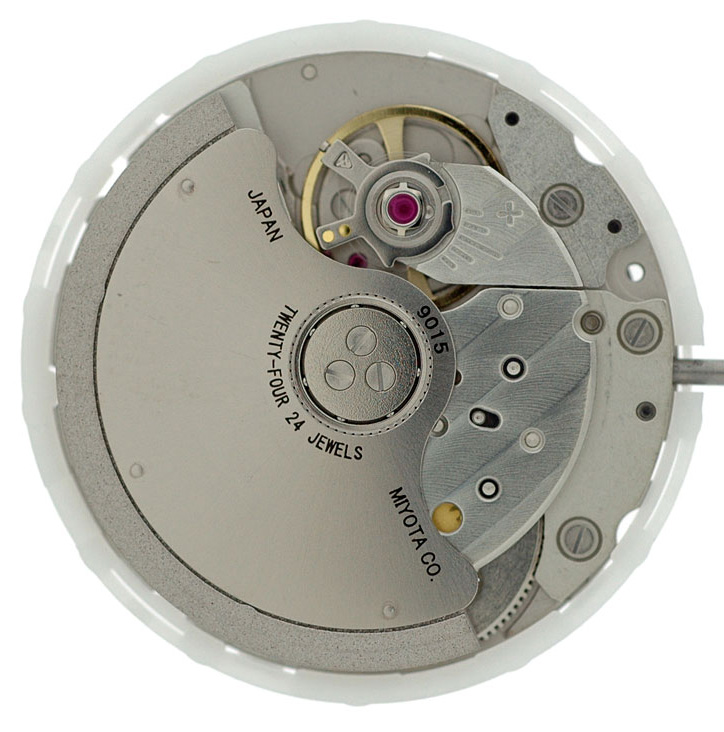
Miyota 9015 (Source: Star Time Supply)
Seventh summary: Japan is an exception in in-house movements due to its unequalled high requirements for quality. Japanese in-house movements are unique, they have been enhanced technically up to a point where no other manufacturer can compete with. Japanese movement makers always offer the best quality for the money, whether it be low or high cost. Availability can be a problem for vintage movement parts, because there isn’t really stocks of old parts.
Third-party movements: the pro’s
- An ETA movement is an extremely reliable movement, that has been enhanced and enhanced during 50 years and more, until it has become completely error-free now. It can take a beating, it is cheap to produce, and easy to service. The Swiss themselves call it “the tractor”.
- “It might be the wiser choice to use a proven sourced movement like from JLC instead of our own”. At least that looks like what the most prestigeous watch brands like IWC (the first Ingenieur), Patek Philippe, Vachéron Constantin, and Audemars Piguet must have thought, when they decided to use a sourced movement instead of their own development.
- There is a good solid choice of generic watch movements from well-known third-party manufacturers to choose from: ETA, Citizen Mijota, Seiko, Soprod, Sellita, Jaeger-LeCoultre, Sea-gull and some others. All are proven. All are not expensive.
In-house movements:
- A trend in past years however has been that more and more watch brands started to develop their own in-house movement. Or co-development of a movement which they share with another brand (Breitling/Tudor for example). This all started as a result of the decision made by ETA to reduce the availability of their movements to not Swiss origin watch brands. This really has been the trigger for a lot of watch brands to decide to invest in developing their own movement. And it resulted in the situation where we are today, being the fact that a lot of watch brands are marketing them.
- In-house can produce revolutionary, amazing looking, fascinating movements. But often the only work on a so-called in-house movement is only some decoration and naming on the rotor.
- Solely because of economic reasons, some well-known watch brands like Nomos, Breitling, Tudor, IWC will use in-house movements only in their more expensive watches. IWC for example still uses ETA-movements in their lower-priced watches, but why pay 10 times more (5400 us$) for an ETA-engined watch, just because it says IWC on the dial?
- Some brands like Habring2 will make their own movement, which will be entirely designed to the original measurements of ETA(Valjoux 7750)-movements for which they already had built add-on complications in past years, but were unable to source in the future due to ETA’s decision. What is the real added-value of such activity, one may ask him/herself? Shouldn’t Habring2 have decided to go for really in-house instead of covering up their strategy?
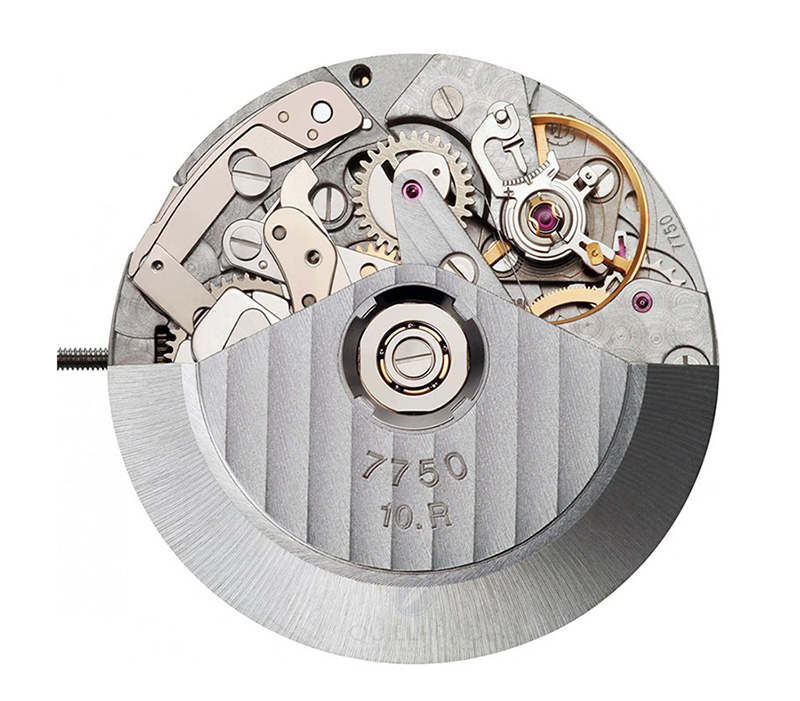
Valjoux 7750 (Source: monochrome-watches)
I am working in the IT industry, and I would like to add an example that will question the value and sense of in-house versus third-party:
- There is not a single manufacturer or brand of personal computers and laptops that is using a self-developed processor. All processors are from only a handful of highly-specialized manufacturers like Intel and AMD for personal computers (HP, Lenovo, even Macbooks), and ARM processors for cell phones (indeed, even in the iPhone).
- So why you may ask, why are in-house movements being seen as ‘the better choice’ in watches?
As a summary I would like to conclude that in-house is not the better choice over a generic movement (with Japan being the exception). In-house will be more exclusive, optically pristine, hand-finished and more expensive. But personally I am happy with the result of 70 years of development that I find in my ETA movements, which will be accurate, sturdy and cheap to maintain.


